
Authors Answer: Kurt Luchs
Authors Answer Q&A #576
Author interviews almost always focus on questions regarding an author’s latest publication (and that’s great because it’s how readers discover new books!) but sometimes it’s fun to ask authors to talk about their lives beyond the book they’ve just written. Authors Answer (started as a blog in 2020, moved onto Substack in 2025), is an attempt to give authors space to wax eloquent about the other influences on their writing. The questions posed here move beyond the formulaic classics like, “What books are on your nightstand?” or “What book inspired you to be a writer?” and even “You’re having a dinner party….which three authors (dead or alive) do you invite?” There are 20 standing questions. Authors pick FIVE that they want to answer.
Are you an author? Visit the Questions page to learn more about participating.
Today’s post features Kurt Luchs
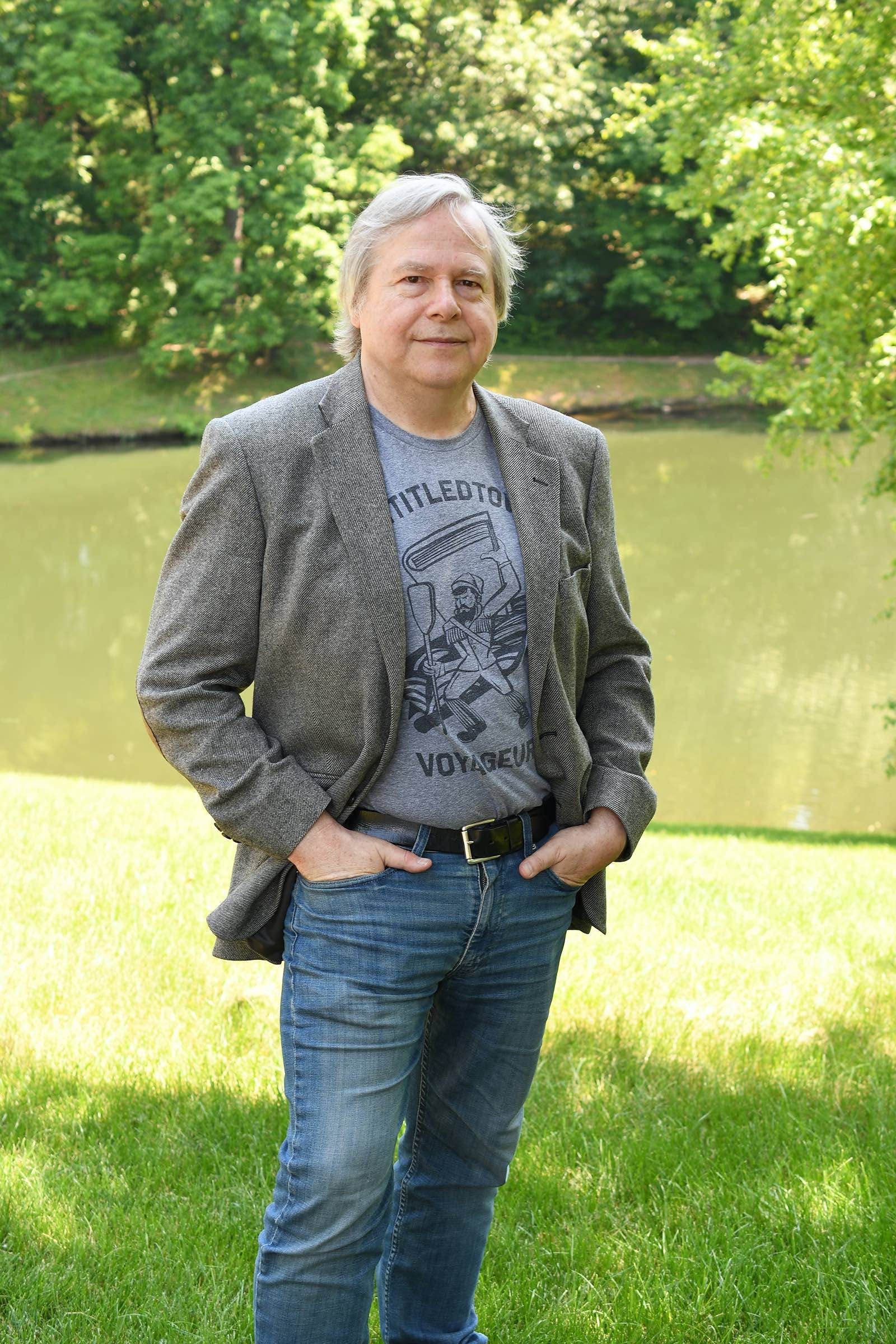
Kurt Luchs won a 2022 Pushcart Prize, a 2021 James Tate Poetry Prize, the 2021 Eyelands Book Award for Short Stories, and the 2019 Atlanta Review International Poetry Contest. He is a Contributing Editor of Exacting Clam. Sagging Meniscus Press published his humor collection, It’s Funny Until Someone Loses an Eye (Then It’s Really Funny) (2017), his poetry collections Falling in the Direction of Up (2021) and Death Row Row Row Your Boat (2024), and his latest book, the hybrid Tributaries: Essays & Verses Flowing from & Celebrating Favorite Poems (2025). He lives in Kalamazoo, Michigan.
Facebook: https://www.facebook.com/kurt.luchs/
Are there particular films that have influenced your writing?
I’ve been an avid movie lover my whole life and films have certainly influenced my writing—different films, depending on the genre of writing. When I was focused on humor earlier in my life, I drew on my love for W. C. Fields, Laurel and Hardy and screwball comedies from Preston Sturges and Howard Hawks, among others. These days when I write poetry, or write about poetry, I am doubtless influenced by the poetic imagery and storytelling of filmmakers like David Lean, Powell and Pressburger, David Lynch, and the greatest of them all, Alfred Hitchcock. What I love most about Hitchcock is that he keeps your conscious mind very busy with witty dialogue and suspense, but his real target is always your subconscious. This is very similar to what poets do. I’m personally fascinated by this, and trying to explain it a bit is one of the main reasons I wrote this latest book.
Is there a genre of music that influences your writing/thinking? Do you listen to music while you write?
As much as I enjoy movies, I am even more enamored with music. For me, there is no such thing as background music. If it’s any good, it demands your full attention, like any art. Even Brian Eno’s “Music for Airports,” which he specifically designed to be background music, demands your full attention. As I say in my tribute poem “Impossibilities” (responding to the Wislawa Szymborska poem “Possibilities”), “If I believe anything, it’s that / the Beatles and J. S. Bach and Bernard Herrmann / will live forever, and if forever isn’t a thing / we’ll have to invent a god to make it one.” Those three musical creators from the seemingly very different worlds of popular music, classical music, and film music, have one crucial thing in common: they were artists determined to continually grow and go beyond what they had already accomplished. None of them were ever content. Again, in this they are very similar to the poets I write about in Tributaries.
What period of history do you wish you knew more about?
That time roughly 74,000 years ago when the Toba supervolcano in the area that would someday be called Sumatra, Indonesia erupted and plunged the world into a nuclear winter that lasted for years and may have created a bottleneck in the small population of humans then alive. We sometimes think we have things rough today or that the world is headed for an apocalypse. Been there, done that.
What’s your favorite comic strip or graphic novel?
My father was a gifted cartoonist and an avid fan of comic strips and comic books. He never made his living at it but probably could have if he didn’t have seven children to feed and house. Though he worked as an advertising copywriter (one of the original Mad Men, Chicago division), he would often do the visual mockups for print or television campaigns. As a result, I grew up knowing more about comic strips and comic books than the average child. Robert Crumb and Jay Lynch, two famous underground cartoonists, were guests in our home. Before I started writing, in fact, I had hopes of being a cartoonist myself. For some reason, the minute I started writing I stopped drawing. Somehow I either lost interest or didn’t know you could practice two arts at once. I still retain a great fondness for the classic early Marvel comics like Spiderman and the Fantastic Four. And I love such strips as Krazy Kat, Peanuts, Flash Gordon and Dick Tracy. As a fan, I never quite made it to the world of graphic novels. I became too interested in more traditional literature.
Have you ever experienced Imposter Syndrome?
No, I’m very comfortable with what I’ve accomplished, and like any ambitious writer much less comfortable with what I haven’t yet accomplished. What I have experienced very frequently could be called “Which Version of Me Wrote That?” Syndrome. I am often surprised to have some previous version of myself revealed when I read something I wrote years ago. By the same token, I am also surprised at some of the enduring traits of one’s personal identity. There are poems I wrote at age 16 that still speak for me.
Endnotes!
This newsletter is a passion project started by me, Elizabeth Rynecki, to try to help shine a light on new-to-me authors. I am also an author (and a documentary filmmaker and podcaster) and if you want to learn more about me, you can visit my website or read my personal newsletter, Ink Trails: A Chronicle in Creativity.
I’ve never made Authors Answer specific social media accounts, but you can find me on Instagram, Threads, and BlueSky.